 NERC Data Catalogue Service
Palaeoenvironment
Type of resources
Available actions
Topics
Keywords
Contact for the resource
Provided by
Years
Formats
Update frequencies
Scale
-

PROJECT DETAILS ONLY - NO DATA. The most sustained steep increase in marine biodiversity took place during the Ordovician. The variety of biogeographical and palaeoecological settings in the British Isles, the historical type area for the Ordovician, makes this a crucial area for understanding the patterns and processes of biodiversity change. Databases on well-constrained spatial and temporal distributions of organisms will be compiled and analysed to answer a series of pertinent questions on the timing, patterns and controls of biodiversity increase and also its implications for the end-Ordovician extinction event. The understanding of these issues will contribute directly and significantly to the global analysis of Ordovician biodiversity change
-
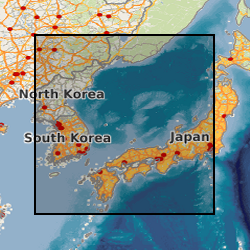
This award was made as a sailing participant of IODP Expedition 346, an international ocean drilling programme that NERC subscribe to. As such there was a lot of data generated that is owned and kept by IODP and which is freely available at: web.iodp.tamu.edu/UWQ/. Published Paper: Integrated Ocean Drilling Program Expedition 346 Scientific Prospectus - Asian Monsoon Onset and evolution of millennial-scale variability of Asian monsoon and its possible relation with Himalaya and Tibetan Plateau uplift. doi:10.2204/iodp.sp.346.2013
-
Determining an accurate timescale for the Vostok ice core using ice-sheet measurements and modelling

PROJECT DETAILS ONLY - NO DATA. The nature of ice-sheet flow between Ridge B and the Vostok sub-ice lake will be determined from a series of measurements and numerical models. Datasets available foe measurements include airborne radar(for ice thickness, internal ice layering, crystal orientation fabric development, and sub-ice conditions), ERS-1 altimetry (for the ice-surface elevation) and interferometric SAR (for the ice-surface velocity). The measurements will form boundary conditions for state-of-the-art models of ice flow. Model results will establish the true nature of ice flow in this region of Antartica. Results will be fundamental to (1) the depth-chronology of the Vostok ice core (2) the examination of the ice-water interaction above the large Vostok subglacial lake and (3) developing traditional models of ice flow in central regions of ice sheets that currently do not replicate the true glaciology.
-

Two Excel workbooks reporting dental microwear texture analysis (DMTA) raw data. These are values from scale-sensitive fractal analysis (SSFA), and areal surface texture analysis (based on a suite of parameters, most of which are defined by ISO-25718-2) for dental microwear texture analysis of tooth surfaces of wolves from Britain (MIS Se & MIS 7 a-c) and modern Poland wolves. This study examines the dietary adaptability of European grey wolves using dental microwear texture analysis (DMTA). These datasets offer new insights into the palaeoclimatic and palaeoenvironmental conditions under which grey wolves endured climate change in the past, free of anthropogenic influence. They further allow the identification of hitherto-hidden ecological stress today, thereby highlighting potential vulnerabilities in modern populations under current and future climate change. Tooth surface casts were produced using high-resolution, which is optimised for imaging purposes. Epoxy tooth replicas were scanned with a Sensofar S neox. MountainsMap Imaging Topography was utilised to quantify dental microwear texture parameters from Sensofar scans.
-
A series of technical palaeontological and biostratigraphical reports produced in the London, Leeds, Edinburgh and Keyworth offices of BGS between 1953 and March 2000. The reports provide information on fossils collected during Geological Survey mapping or supplied by clients. Fossils are collected in order to date (relative age) the rocks in which they occur and/or to provide evidence for the conditions of deposition, so the information contained in each report usually includes determinations of the fossils present in a collection and an interpretation of their stratigraphical and/or their palaeoenvironmental/palaeogeographical significance.Individual reports vary enormously in scope, depending on the reasons for the investigation. Some reports may be site specific, documenting the fossil fauna/flora from a particular locality or borehole, whereas others may deal with material from a number of localities on a 1:10 000, 1:25 000 or 1:50 000 sheet, or from several boreholes. Other reports may be in the form of reviews. Geographical coverage is wide, covering the UK and Northern Ireland onshore, UK offshore and overseas localities.All reports are held as hardcopy only. Each report bears a unique identifying number in the form SS/YY/NN, where 'SS' identifies the series, 'YY' identifies the year in which it was written and 'NN' is a serial number. Reports were numbered sequentially, regardless of whether they dealt with material from the UK and Northern Ireland onshore, UK offshore, or overseas, and a sequential set is held by BGS. Reports are also filed by 1:50 000 sheet, (UK onshore), offshore quadrant and foreign country, as appropriate.
-

One Excel workbook reporting dental microwear texture analysis (DMTA) raw data. These are values from scale-sensitive fractal analysis (SSFA), and areal surface texture analysis (based on a suite of parameters, most of which are defined by ISO-25718-2) for dental microwear texture analysis of tooth surfaces of wolves from Britain (MIS 2, MIS 3, MIS 5a). This study examines the dietary adaptability of European grey wolves using dental microwear texture analysis (DMTA). These datasets offer new insights into the palaeoclimatic and palaeoenvironmental conditions under which grey wolves endured climate change in the past, free of anthropogenic influence. Tooth surface casts were produced using high-resolution, which is optimised for imaging purposes. Epoxy tooth replicas were scanned with a Sensofar S neox. MountainsMap Imaging Topography was utilised to quantify dental microwear texture parameters from Sensofar scans.
-
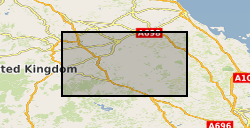
The data set consists of rock samples collected from Coquetdale, Coldstream and Whitrope Burn from 2013-2014; milled material is included. There is an Excel spreadsheet of sample numbers with location, sample height on log, d13C data and %C. There are scans of field logs from Coquetdale, Coldstream and Whitrope Burn, and Illustrator drawn logs from Coldstream which include samples collected at a later date. Scans of thin sections are also included. (thin sections to be kept at Leicester for the time being – still being worked on for papers.) Each locality folder has an Excel spreadsheet detailing samples, sample height, %C and bulk and specific d13C values. These data were used to interpret the environment in which early tetrapods have been found in the early Carboniferous. These data supported the MPhil thesis 'In an alternating marine and non-marine depositional setting, where and how are early Carboniferous tetrapods preserved?' by Sherwin, 2018, and one publication including data from Whitrope Burn - Richards et al., 2018, (https://doi.org/10.1017/S1755691018000166).
-

PROJECT DETAILS ONLY - NO DATA. Seasonal stratification is a widespread phenomenon of shelf seas which influences climate both regionally and through land sea heat exchange and globally through impacts on marine bioproduction and therefore the carbon cycle. This proposal seeks to investigate the long term (103 -104 years) dynamics of shelf sea stratification with the aim of defining the climatic role of physical and biogeochemical processes operating in extensive shallow seas during eustatic highstands. The proposal builds on Holocene modelling and observational pilot study from the Celtic sea by (1) an investigation of stable isotopic (oxygen, carbon) content of living benthic foraminifera from across the Celtic sea frontal region and (2) stable isotopic and faunal investigation of AMS 14C-dated Holocene cores underlying mixed, frontal and stratified localities in this area
-

This dataset has been superseded, the latest version is version 2, http://data.bgs.ac.uk/id/dataHolding/13608613 Dental microwear texture analysis (DMTA) raw data. These are values from scale-sensitive fractal analysis (SSFA), and areal surface texture analysis (based on a suite of parameters, most of which are defined by ISO-25718-2) for dental microwear texture analysis of tooth surfaces of wolves from Britain (MIS 5e & MIS 7 a-c) and modern Poland wolves. This study examines the dietary adaptability of European grey wolves using dental microwear texture analysis (DMTA). We compare modern Polish wolf populations from the present interglacial (Holocene), with fossil specimens from two contrasting Pleistocene interglacials: the warmer Last Interglacial (Marine Oxygen Isotope Stage [MIS] 5e) and the cooler Penultimate Interglacial (MIS 7a–c). These datasets offer new insights into the palaeoclimatic and palaeoenvironmental conditions under which grey wolves endured climate change in the past, free of anthropogenic influence. And allows the identification of hitherto-hidden ecological stress today, thereby highlighting potential vulnerabilities in modern populations under current and future climate change.
-

PROJECT DETAILS ONLY - NO DATA. A pilot study in the Taf estuary, South Wales (Carman et al., in press) has demonstrated the potential of Testate amoebae analyses in reconstructing high-resolution Holocene sea-level changes. Testate amobae faunas in surface samples from the saltmarsh were found to be not vey abundant and diverse, but also distinctly zoned with respect to elevation. This new finding is based on analyses of the sub-63 um size sediment fraction; previous saltmarsh studies only recorded larger testate amoebae in very low numbers and low diversity. We propose to test the replicability and applicability of Testate amoebae in sea-level studies by (i) sampling and analysing a new transect in the Brancaster marshes in the North Norfolk; and analysing fossil samples from the University of Durham core archive representing a wide range of coastal palaeo-environments.