 NERC Data Catalogue Service
Image (SVG)
Type of resources
Available actions
Topics
Keywords
Contact for the resource
Provided by
Years
Formats
Representation types
Update frequencies
Service types
Scale
-
This layer of the Map based index (GeoIndex) shows where water wells exist with data available on transmissivity, storativity and discharge/drawdown. These parameters indicate the physical characteristics of the aquifer which can relate to factors such as possible storage capacities or rate of movement of water through the rock.
-
BGS soil property data layers including parent material, soil texture, group, grain size, thickness and European Soil Bureau description. These data are delivered under the terms of the Open Government Licence (http://www.nationalarchives.gov.uk/doc/open-government-licence/), subject to the following acknowledgement accompanying the reproduced BGS materials: Contains British Geological Survey materials copyright NERC [year]. Contact us if you create something new and innovative that could benefit others usingbgsdata@bgs.ac.uk.
-
The 1:50 000 scale GeoSure (natural ground stability) data covering the map sheets for Loughborough and Kilmarnock are available in this OGC WMS service for personal, non-commercial use only. This service is a contribution to the OneGeology-Europe initiative. For information about more of the British Geological Survey's maps and other digital products please visit http://www.bgs.ac.uk/products. MapServer software is used to provide this OGC WMS service.
-
Data from the British Geological Survey's GeoIndex Collections theme are made available for viewing here. GeoIndex is a website that allows users to search for information about BGS data collections covering the UK and other areas world wide. Access is free, the interface is easy to use, and it has been developed to enable users to check coverage of different types of data and find out some background information about the data. More detailed information can be obtained by further enquiry via the web site: www.bgs.ac.uk/geoindex.
-
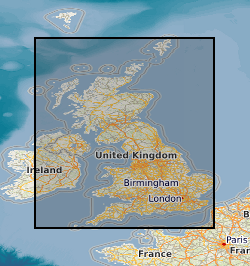
The map shows the localities where samples that form part of the BGS rock collections have been taken. Many of these samples are from surface exposure, and were collected by BGS geologists during the course of geological mapping programmes. Others are from onshore boreholes or from mine and quarry workings. The principal collections are the E (England and Wales), S (Scotland), N (continuation of the S collection) and the MR (miscellaneous). The collections, which are held at the BGS offices at Keyworth (Nottingham) and Edinburgh, comprise both hand specimens and thin sections, although in individual samples either may not be immediately available. Users may also note that the BGS holds major collections of borehole cores and hand specimens as well as over a million palaeontological samples. The Britrocks database provides an index to these collections. With over 120,000 records, it now holds data for some 70% of the entire collections, including the UK samples shown in this application as well as rocks from overseas locations and reference minerals. The collections are continuously being added to and sample records from archived registers are also being copied into the electronic database. Map coverage is thin in some areas where copying from original paper registers has not been completed. Further information on Britrocks samples in these and other areas can be obtained from the Chief Curator at the BGS Keyworth (Nottingham) office or from the rock curator at the BGS Murchison House (Edinburgh) office.
-
The British Geological Survey (BGS) in collaboration with the Environment Agency (EA) has developed a web-based tool that provides an indication of whether suitable conditions exist in a given area for Open-loop Ground Source Heat Pumps (GSHP). The tool is developed within a GIS and maps the potential for open-loop GSHP installations (heating/cooling output >100kW) in England and Wales at the 1:250,000 scale. Data layers from this tool are available to view in this service. The data in this service is available to access for free on the basis it is only used for your personal, teaching, and research purposes provided all are non-commercial in nature as described on http://www.bgs.ac.uk/about/copyright/non_commercial_use.html. Where commercial use is required, licences are available from the British Geological Survey (BGS). Your use of any information provided by the BGS is at your own risk. BGS gives no warranty, condition or representation as to the quality, accuracy or completeness of the information or its suitability for any use or purpose. All implied conditions relating to the quality or suitability of the information, and all liabilities arising from the supply of the information (including any liability arising in negligence) are excluded to the fullest extent permitted by law.
-
The BGS has been commissioned by Defra to provide guidance on what are 'normal' levels of contaminant concentrations in English soils in support of the revision of the Part 2A Contaminated Land Statutory Guidance. The domain polygons and other data produced by this work are served as WMS here.
-
The joint PHE-BGS digital Indicative Atlas of Radon in Great Britain presents an overview of the results of detailed mapping of radon potential, defined as the estimated percentage of homes in an area above the radon Action Level. The Indicative Atlas of Radon in Great Britain presents a simplified version of the Radon Potential Dataset for Great Britain with each 1-km grid square being classed according to the highest radon potential found within it, so is indicative rather than definitive. The joint PHE-BGS digital Radon Potential Dataset for Great Britain provides the current definitive map of radon Affected Areas in Great Britain.
-
Information for this layer of the map based index (GeoIndex) is taken from the BGS National Landslide Database (NLD), which holds over 15000 records of landslides and is the definitive source of landslide information for Great Britain (excludes Northern Ireland, Isle of Man and the Channel Islands). Each landslide within the National Landslide Database is identified by a National Landslide Database ID number and a point location, as shown on this map. The National Landslide Database ID number represents an individual survey of a landslide, rather than just the landslide itself. This is because there could be several phases of movement within or extensions to the same landslide, particularly if it is a large and complex one. Subsequent surveys of the same landslide may be recorded in the database with the same National Landslide Database ID number but with a new Survey Number. Other information given for each record include; Landslide name, grid reference and whether the landslide record has been validated by the BGS Landslides Team. The point symbols at the designated location do not reflect the size and shape of the corresponding landslide, but just denote the recorded presence of a landslide within a range of accuracy.
-
High Resolution, Airborne Magnetic, Radiometric, VLF Survey over north Midlands of GB. Survey flying for the collaborative BGS and World Geoscience Corporation Ltd (WGC) high resolution geophysical and environmental survey was completed in early September 1998. The data comprise multi-channel gamma ray spectrometer, magnetometer and dual frequency VLF-EM. Flight line spacing was 400 m with tie lines at 1200 m and the total area surveyed is some 14 000 km2. Flight-line orientations are W–E over the western survey area, SW–NE over the eastern area. Ground clearance was maintained at 90 m in rural areas, increasing to about 240 m in built-up zones.