
XML
Type of resources
Available actions
Topics
Keywords
Contact for the resource
Provided by
Years
Formats
Representation types
Update frequencies
Service types
Scale
Resolution
-

This service is a BGS contribution to the OneGeology project, providing UK onshore bedrock geological data at 1:625 000 scale in GeoSciML. This map data is collected as part of an ongoing BGS project: Digital Geological Map of Great Britain (DiGMapGB). GeoServer software is used to provide this complex features WFS service.
-
This service is an INSPIRE download WFS service, providing UK onshore bedrock geological data at 1:625 000 scale. This map data is collected as part of an ongoing BGS project: Digital Geological Map of Great Britain (DiGMapGB). GeoServer software is used to provide this WFS service. This service is delivering MappedFeatures specified by GeologicUnits, the geological history of which is recorded by GeologicEvents.
-

BGS Data Catalogue discovery service API. Provides human and computer accessible interface to BGS metadata records
-
This dataset contains photographs from an optical microscope by transmitted light and reflected light. The data was collected in 2022-2023. The data was collected for the purpose of visualising spatial textures and microstructures in the collected samples. The data was collected by John MacDonald and Robin Hilderman (University of Glasgow) who retain the original data.
-

BGS’s Data Catalogue, which provides Open Geospatial Consortium "Catalogue Service for the Web" (CSW) access to information about British Geological Survey (BGS) datasets, services (including APIs), and series. At present, this is mainly used to feed data.gov.uk for other information about BGS please go to our website (https://www.bgs.ac.uk/) and data pages (https://www.bgs.ac.uk/geological-data/).
-
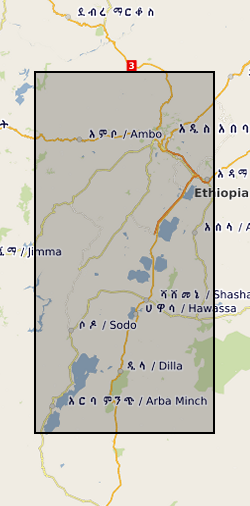
This data set contains a set of 226 unwrapped, geocoded interferograms derived from InSAR scenes processed over Corbetti Volcano, Ethiopia. The data were assembled from multiple sensors and processed using either the ICSE or GAMMA software package. The images presented here are generally not the same size as the raw InSAR images but instead are cropped to the extents of the volcano and its immediate environs.
-
This dataset contains outputs from the numerical simulations of a single cylindrical woody debris being released in a flume (0.6 m wide and 6.0 m long) with a flow depth of 0.208 m and travelling downstream. The outputs include: position, orientation, linear velocity and acceleration, and angular velocity and acceleration. The simulations were carried out by using DualSPHysics, an open source SPH-based modelling framework. Four flow conditions and three different initial orientations (0, -5 and +5 deg) were simulated. Full details about this nonGeographicDataset can be found at https://doi.org/10.5285/2221837a-98b9-4802-9e10-72b6e9c84136
-
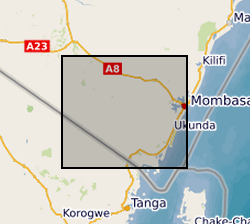
The data set contains Soil Data used in the Gro for GooD Project in Kwale, Kenya based on KENSOTER database and soil survey in study area. The KENSOTER dataset, specific for Kenya, was compiled by the Kenya Soil Survey (KSS) and ISRIC and released in 2006 where ISRIC plays a lead role in methodology development and programme implementation (http://www.isric.org/projects/soil-and-terrain-soter-database-programme). The dataset includes over 600 soil components, including synthetic profiles, which have been derived from soil survey reports and expert knowledge. The second version of the dataset which has been made available includes additional soil profile database and is also used for the assessment of soil carbon stocks. The gaps in the measured soil profile data have been filled using a step-wise procedure which includes three main stages: (1) collate additional measured soil analytical data where available; (2) fill gaps using expert knowledge and common sense; (3) fill the remaining gaps using a scheme of taxotransfer rules. Parameter estimates are presented by soil unit for fixed depth intervals of 0.2 m to 1 m depth for: organic carbon, total nitrogen, pH(H2O), CECsoil, CECclay, base saturation, effective CEC, aluminium saturation, CaCO3 content, gypsum content, exchangeable sodium percentage (ESP), electrical conductivity of saturated paste (ECe), bulk density, content of sand, silt and clay, content of coarse fragments, and available water capacity. The data have recently been used for the Green Water Credit (GWC) programme in the Upper Tana River Valley. This dataset was prepared for the Gro for GooD project by Mike Thomas, Rural Focus Ltd., Kenya; John Gathenya, JKUAT, Kenya. Gro for GooD: Groundwater Risk Management for Growth and Development
-
These data are input files for CAESAR-Lisflood (CL), a numerical hydrodynamic-landscape evolution model. These files were created to support coupled hydrodynamic-landscape evolution modelling to evaluate the geomorphological response of river channels affected by the 7th February 2021 ice-rock avalanche and debris flow in Chamoli District, Uttarakhand, India. They include 10 m digital elevation models (DEMs) of bed rock and land surface topography in a gridded (raster) format. They also include reanalysis-derived river discharge data generated by the GEOGloWS project at the following locations: Rontigad, Rishiganga, Dhauliganga, and Alaknanda. The configuration settings and parameters for CL modelling are also included. Full details about this dataset can be found at https://doi.org/10.5285/4cdd86b3-bf58-457d-b8cf-b57aed2d56d0
-

This dataset comprises ECLIPSE input decks for a 3D reservoir simulation of the CO2 plume at the Sleipner CO2 injection site. This whole reservoir model is an attempt to history match the growth of the plume observed on seismic data. A seismic velocity and density model derived from the 3D reservoir simulation is also included, together with a series of Seismic Unix scripts to create a synthetic seismic section through the Sleipner reservoir model, for comparison with released time-lapse seismic data.